
Cancer clinical trials in Germany test new treatments under strict EU and German oversight, and international patients can apply. Places are limited: you must meet each trial’s medical criteria, attend regular visits in person, and understand the consent form. The trial sponsor usually covers the study drug, while travel and routine care are often your cost. Start with a records review so a specialist can check which trials genuinely fit your case.
“There’s nothing more we can offer you here.” For many families, that sentence is where the search for cancer clinical trials in Germany begins. It often happens late at night, with a lot of hope riding on it.
Germany is one of Europe’s busiest research countries, and international patients can apply for its trials. But a trial isn’t a back door to a cure, and it isn’t open to everyone. Each study has strict entry rules, and the team running it decides who joins.
This guide explains how trials work in Germany, who tends to qualify, what you’ll pay, and what to do if no trial fits. The right first step is rarely booking a flight. It’s getting your full records in front of a specialist who can tell you honestly whether a trial is realistic for your cancer.
At Cancer Rounds, we help international patients do exactly that. If a standard route makes more sense, we can also plan cancer treatment in Germany with certified centres instead.
Confused about treatment options?
Get a free second opinion from our oncologists
A cancer clinical trial in Germany is a regulated research study that tests a new drug, combination or technique, usually against today’s best standard treatment. Every drug trial needs approval from a federal regulator and an independent ethics committee before the first patient is treated, and it must follow EU-wide rules.
Germany follows the EU Clinical Trials Regulation, the same rulebook used across the bloc. Two federal bodies, the BfArM (Federal Institute for Drugs and Medical Devices) and the Paul-Ehrlich-Institut, handle trial approvals. An ethics committee also checks that the study is fair and safe for the people taking part.
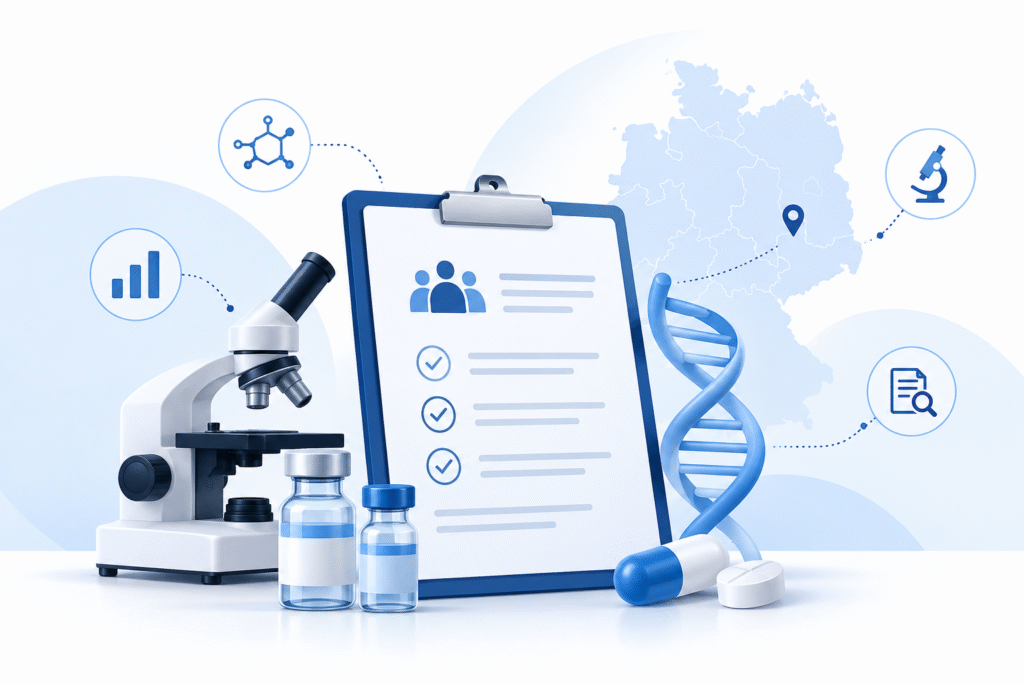
You’ll often see the word “sponsor”. That’s the company or university that funds and runs the trial. The doctor leading it at each hospital is called the investigator.
Trials are also registered publicly, which helps you check that a study is genuine. The German register, known as the DRKS, has been a WHO-recognised registry since 2008, and patients can search it for suitable studies. Commercial drug trials must be registered in the EU’s Clinical Trials Information System (CTIS).
Yes. Nationality is rarely an exclusion in itself. What decides it is whether you meet the trial’s medical criteria, can stay in Germany for every scheduled visit and scan, and can understand the consent form. In practice, foreign participants are still a small minority in most trials.
Researchers who studied cross-border trial access found that half of the investigators surveyed saw fewer than 1% foreign patients in their trials. The same study placed Germany in the top ten countries for attracting trial participants from abroad. So it happens, but it takes planning.
Language is the first hurdle. In Germany, a patient who can’t read the consent form can’t join the trial. Some studies only have an approved German version, so ask early whether an English consent form exists.
Time is the second hurdle. Trials need frequent, fixed visits for treatment, blood tests and scans, and investigators describe this as hard for patients who travel. You may need to stay for several weeks or months, so think about accommodation, a companion and time off work.
Before you commit to anything, our team checks the language of the consent form and the visit schedule with the trial site. That way you know what’s really involved.
Germany runs a large share of Europe’s cancer research. It started 541 industry-sponsored trials in 2024, close behind Spain’s 601. After Spain, Germany also hosts the most multicentre trials in Europe, meaning studies run across several hospitals at once.
It hasn’t always been smooth. Commercial trials in Germany fell from 618 to 417 between 2018 and 2023. In response, the Medical Research Act came into force on 30 October 2024. Its main aim is to cut the time it takes to start a trial through faster approvals and quicker contract talks.
Where you’re treated matters too. In a large US study, enrolment in treatment trials was more than five times higher at major cancer centres than at community sites (21.6% against 4.1%). The same logic applies in Germany: research-linked university centres open far more studies than smaller hospitals.
Trials move through phases, and each one asks a different question. In the early phases, researchers work out safety, side effects and the best dose. In phase 3, they test whether the new treatment works better than the current standard.
Phase 2 studies usually focus on one cancer type and include fewer than 100 patients. That’s why many trials you find will be closed to your cancer type even if the drug sounds promising.
| Phase | Main question | Typical size | What it means for you |
| Phase 1 | Is it safe, and at what dose? | Small groups | The most unknowns and the closest monitoring |
| Phase 2 | Does it work in one cancer type? | Usually under 100 | Some early evidence, still uncertain |
| Phase 3 | Is it better than standard treatment? | Hundreds or more | You may be assigned to standard care instead |
| Phase 4 | How does it perform long term? | Large | The drug is already approved |
Later phases aren’t risk-free. They’re simply better understood. Ask the trial team which phase you’d join and what that means for your own situation.
Start with your full records and a specialist review. Then search registered trials, contact the trial site and complete its screening tests before you travel for enrolment. The trial team, not you or any facilitator, makes the final decision on whether you can join.
Here’s how the process usually runs:
At Cancer Rounds, a dedicated case manager handles the heavy lifting: organising and translating records, shortlisting suitable trials, and liaising with hospital international offices. We offer support in 11+ languages, so you’re never trying to read a German email alone.
A trial isn’t free for most international patients. The sponsor usually pays for the study drug and the tests done only for the trial. Flights, accommodation, interpreters and often some routine hospital care are costs you should plan and budget for yourself.
Most studies provide the drug being tested free of charge, but routine care costs may not be covered. On top of that, most trials don’t cover travel, housing, transport or meals.
| Cost | Usually paid by | What to ask |
| Study drug | Trial sponsor | Is it covered in every arm, including the comparison group? |
| Trial-only tests and scans | Trial sponsor | Is every extra procedure included, or only some? |
| Routine hospital care | Often the patient | Which visits and tests will be billed to me? |
| Travel, stay and meals | The patient | Does the sponsor offer any travel support? |
| Interpreter and coordination | The patient or facilitator | Is a medical interpreter available at each visit? |
Always get the cost split in writing before you sign. For standard treatment prices you can compare against, see our guide to cancer treatment costs in Germany.
Many patients don’t qualify for any open trial. That doesn’t always mean the options have run out.
Germany has run compassionate use programmes, also called hardship programmes, since 2010 under its Medicines Act. They let doctors use a drug that isn’t yet approved. Taking part in a trial must be ruled out first, and the manufacturer supplies the drug free of charge.
The rules are strict. You must have a life-threatening illness that approved treatments can’t treat satisfactorily. The manufacturer registers each programme with the BfArM or the PEI, and each one sets the exact diagnosis a patient must have.
The other route is approved, advanced treatment that may not be available in your home country. Options such as immunotherapy in Germany and CAR-T cell therapy are already part of standard care for certain cancers. For some patients, they’re a faster and more certain path than waiting for a trial place.
Cancer clinical trials in Germany are open to international patients, but places are tightly screened. You’ll need to meet the medical criteria, understand the consent form and stay for every visit. Trials also aren’t free: the sponsor usually covers the study drug, while travel and some routine care fall to you.
The most useful thing you can do today is get your records reviewed. A specialist can tell you whether a trial, a compassionate use programme or approved treatment is the right next step.
Send your reports to Cancer Rounds for a free trial-eligibility review, or talk to one of our oncologists in Germany. Not ready yet? Request a callback, ask about treatment costs, or start a WhatsApp chat with our team. Whatever you decide, you won’t have to work it out alone.
Yes, if you meet the trial’s medical criteria, can understand the consent form and can stay for all scheduled visits. Nationality is rarely an exclusion in itself. Foreign participants are still a small minority in most trials, so a records review before travel is the best place to start.
It depends on your cancer type, stage, previous treatments, tumour biomarkers and general fitness. Each trial sets its own entry rules, and not qualifying is common: in one large study, more than 20% of patients didn’t meet the eligibility criteria. A specialist review of your records shows which trials genuinely fit.
Not fully. The sponsor usually pays for the study drug and trial-only tests, but most trials don’t cover travel, housing, transport or meals. Some routine hospital care may also be billed to you, so compare it against standard cancer treatment costs in Germany.
Every drug trial in Germany needs approval from a federal regulator and an ethics committee, and patients are monitored closely. Even so, new treatments can cause side effects that aren’t yet known. Early-phase trials carry the most unknowns because they’re still working out safety and the right dose.
A clinical trial is a research study with fixed entry rules that compares a new treatment against current care. Compassionate use gives an unapproved drug to patients with a life-threatening illness and no satisfactory approved option. In Germany, trial participation must be ruled out before compassionate use is considered.
Most patients from outside the EU and Schengen area need a visa: a national visa for stays over 90 days or a Schengen visa for shorter treatment. The trial site or hospital usually provides the invitation letter you’ll need. Our guide to the German medical visa covers documents and timelines.
You can look at other open trials, a compassionate use programme, or approved advanced treatments such as immunotherapy or CAR-T cell therapy. If you’re already in a trial and the treatment stops working, the trial team will explain your options and how to leave the study. Your case manager can then help plan the next step.
.webp)
Get expert guidance instantly
Tell us about your condition and we will help you find the right care.
Get expert guidance instantly
Share a few details and our medical team gets back to you within 4 hours with the next steps.
Tell us what you are facing and our medical team will guide you to the right doctors, hospitals and treatment.
Free Review, No Commitment
Free assessment with no pressure to proceed.
Trusted by 100,000+ Patients
Across 125+ countries worldwide
500+ Top Partner Hospitals
Globally accredited medical facilities
5000+ Expert Specialists
Senior doctors across major specialties.
Making quality healthcare accessible to patients worldwide
Everything you need to know about choosing the right hospital, doctor and treatment plan.